

By Gregg Andrews
Hollywood in the 1930s paid a good deal of attention to life on the Mississippi River. “Banjo on My Knee,” a 20th Century-Fox Film Corporation production, hit theaters in December 1936, about six months after Universal’s second film adaptation of Edna Ferber’s 1926 novel, Showboat, was released. A musical comedy-drama adapted from a popular novel by Harry Hamilton, “Banjo on My Knee,” no matter its limits and lingering influences of minstrelsy, represented an improvement in the way shantyboat communities were portrayed in the movies. This is certainly true in comparison to the caricatures of shantyboat settlements and steamboat roustabouts depicted by film director Russell Mack in the 1931 movie, “Heaven on Earth,” and in director John Ford’s 1935 release, “Steamboat Round the Bend.” The latter two movies were based on novels by Ben Lucien Burman, whose depictions of waterfront communities were based on the crudest of racist images and stereotypes.
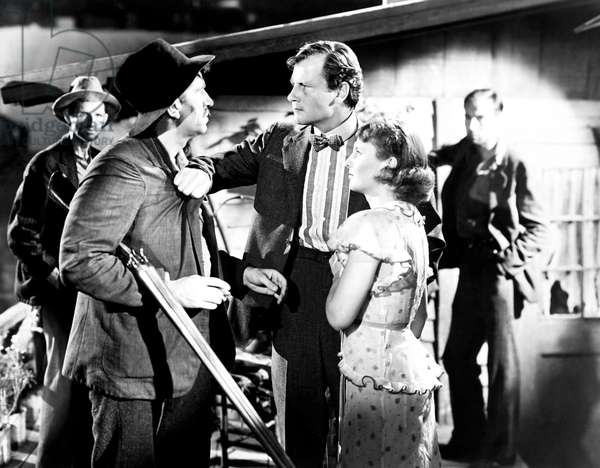
At the center of “Banjo on My Knee” is the Holley family, who live in a shantyboat settlement on a Mississippi River sandbar at Island 21 above Memphis, near Pecan Point, Tennessee. Nunnally Johnson wrote the screenplay, and William Faulkner played an uncredited role in its early drafts. The movie, directed by John Cromwell and produced by Darryl F. Zanuck, features Walter Brennan as Newt, toothless patriarch of the musical family who had lost all his sons to drownings except Ernie, played by actor Joel McRae. Cast as Pearl Elliott, a “land girl,” actor Barbara Stanwyck marries Ernie on the shantyboat in the opening scene. Newt, joyful he might get a grandson at last, plays a homemade musical contraption that combines banjo, harmonica, kettle drums, cowbells, and cymbals to celebrate the wedding. Buddy, a nephew played by Buddy Ebsen, sings and dances at the wedding, and in the five-minute clip below, he and Pearl dance together in New Orleans. For Stanwyck, it was her first time to sing and dance on the big screen.
During the wedding celebration, Ernie punches and knocks overboard an intoxicated guest, Mr. Slade (actor Victor Killian), for trying to force an unwelcome kiss on his new bride. Ernie, who mistakenly thinks he killed Slade when he didn’t come up to the water’s surface immediately, takes off down the river to New Orleans without Pearl before they consummate the marriage. As a shanty boat dweller, he fears he would automatically be convicted of murder, no matter what. While he ships out as a sailor on the lam, Pearl tires of waiting for him to come home. She runs off to New Orleans with a photographer who promises her work in his studio, but when she resists his romantic advances, she ends up working as a dish washer in the Creole, a restaurant/bar in the French Quarter. Chick Bean, a crooner in the restaurant played by singer Tony Martin, falls madly in love with her and invites her to go with him to Chicago, where audiences will better appreciate his style of singing.
In the film’s most evocative footage on the New Orleans wharf, singer Theresa Harris, a talented actor, singer, and dancer who resented being confined mostly to uncredited roles in Hollywood for racist reasons, sings a powerful, stunning rendition of W.C. Handy’s 1914 “St. Louis Blues” in yet another uncredited role. The Hall Johnson Choir, organized by Frances Hall Johnson in 1925 to showcase Black spirituals, provides backing for her on the song, which was Newt’s favorite. Stevedores or roustabouts load steamboats in the background while a melancholy Pearl stares at the river, trying to decide whether to leave New Orleans with Chick.
Newt goes looking for Pearl, trying to get her and his son back together. In a series of misadventures, misunderstandings, and maddening timing, Ernie and Pearl spend the rest of the movie mostly apart as he ships out on another freighter after punching out the photographer in New Orleans. Of course, Newt gets to play his weird musical contraption in the Creole, where the audience goes wild over his raucous, racy, and swingy offbeat river rhythms and melodies, preferring them to Chick Bean’s smooth vocal stylings. And, of course, Ernie and Pearl at last reunite, and Newt gets a chance to have a grandson!
Banjo on My Knee provided escapist entertainment at a time of national and international gravity in the late 1930s. Although it provided moviegoers with a few good laughs, it hit a roadblock with Hollywood censors. The movie industry’s Production Code Administration (PCA), created in 1934 to produce more wholesome, less controversial films, red flagged “Banjo on My Knee.” Joseph Breen, head of the PCA, warned Zanuck after a reading of the script that it would be rejected unless changes were made to get rid of the “excessive drinking” and sexual focus. The running theme of Newt’s efforts to get Ernie and Pearl together behind closed doors to consummate the marriage and produce a grandson offended someone at the PCA. Incredulous, Zanuck protested: “Your reader has injected smut and sex where none was ever intended.” Zanuck did cut back on the amount of drinking in scenes, but in defense of the script, he added, “We are telling a beautiful love story laid among a certain type of river people that exist on the Mississippi today. They are not drunks; they are not whores. . . “[1]
In case you’d like to watch the movie, attached below is a link where you can view it on Youtube.
[1] On the quoted exchange between Breen and Zanuck, see the American Film Institute’s Catalog, Banjo on My Knee, December 11, 1936, https://catalog.afi.com/Catalog/moviedetails/3973.
 Lost River Stories
Leave a comment