

By Gregg Andrews
From 1961 to 1964, a grand old steamboat, the River Queen, was berthed on the silty shoreline of East Hannibal, just north of the Illinois approach to Highway 36 and the Mark Twain Memorial Bridge. Hannibal-St. Louis businessmen, Arthur L. Krato and John C. Groffel, operated the Queen as a restaurant, museum, and bar with LIVE Dixieland music and plenty of crispy catfish. An advertising sign that featured snippets of the converted steamboat’s history is in the University of Wisconsin-La Crosse’s Historic Steamboat Photographs Collection. Neither the location nor the date of the sign is provided, but it might have been used by Krato and Groffel on the East Hannibal riverfront. Or, perhaps by a previous owner who used the Queen for similar entertainment purposes in New Orleans. Whatever the case, Yvonne DeCarlo’s name on the sign indicates that it was designed sometime after 1957, when she and Clark Gable starred in Hollywood’s Band of Angels. Warner Bros. Pictures leased the River Queen, towed her to Baton Rouge, and used her as the Golden Fleece in the filming of the movie.
On July 26, 1961, Krato and Groffel bought the Queen at a bankruptcy auction in New Orleans and towed her up the Mississippi River to Hannibal. Built in 1923 at the popular Howard Shipyard in Jeffersonville, Indiana, the steel-constructed sternwheeler hauled freight and passengers until 1931 as the Eagle Packet Company’s third incarnation of the Cape Girardeau.

As the packet trade died, the Eagle Packet Company used the steamer as a tourist excursion boat until 1935, when the Cincinnati based Greene Line Steamers, Inc., bought and renamed her the Gordon C. Greene. After the Cincinnati company stopped hauling freight in 1947, the Gordon C. Greene was adapted for use again as an excursion boat between St. Louis and St. Paul until 1952. Expendable as a result of the Greene Line’s purchase of the Delta Queen in 1948, the Gordon C. Greene went through several additional owners and uses before ending up on the auction block in New Orleans in 1961.
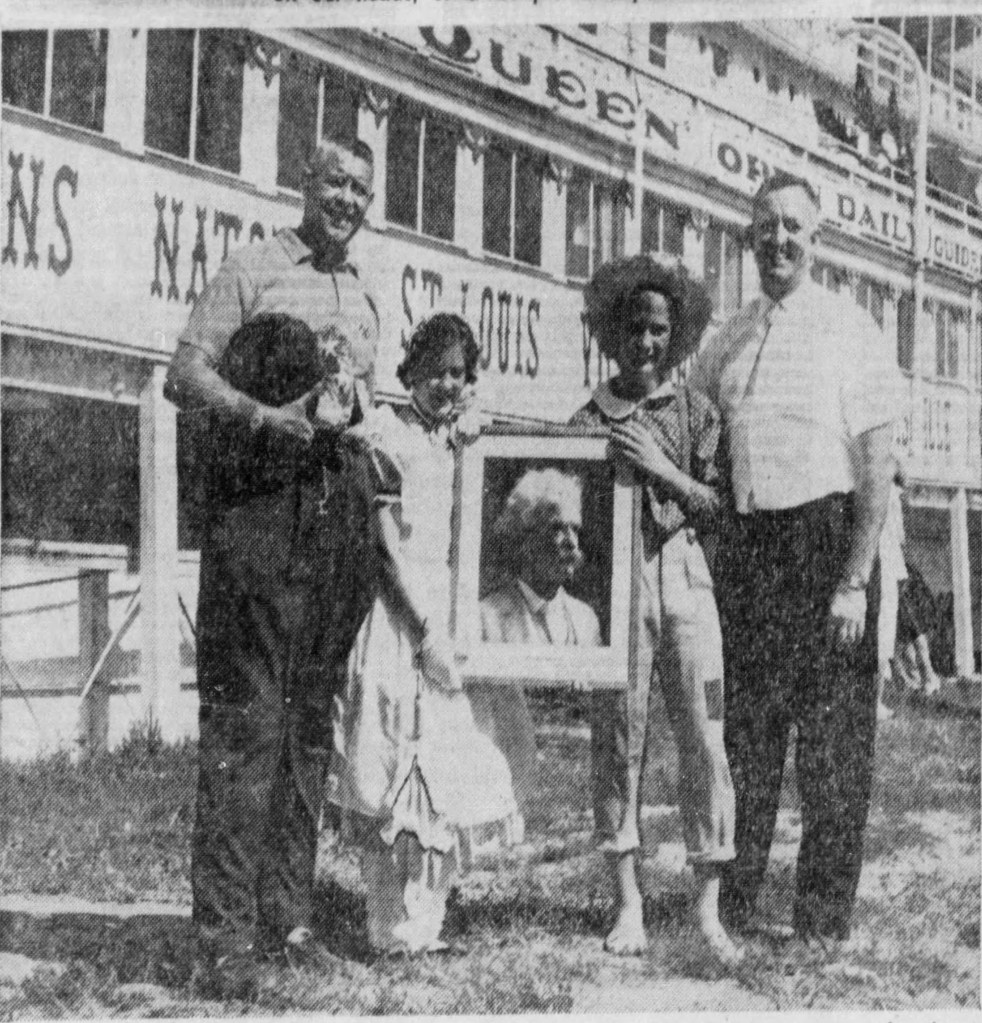
Krato and Groffel bought the River Queen for $49,100 and paid $7,500 to have her towed to Hannibal for use as a restaurant, bar, and museum. At first, they considered St. Louis as a home for the Queen, but they chose Hannibal because of its Mark Twain tourism. The new owners were aware that previous attempts to use the boat for entertainment purposes, including theatre, failed in Owensboro, Kentucky, Bradenton, Florida, and New Orleans. But, they knew, too, that Hollywood used the steamer in Steamboat Round the Bend (1935), Gone with the Wind (1939), Kentuckian (1955), and Band of Angels (1957). “Well, we can always bill her as the movie star of the river,” Groffel told Jack Rice, a St. Louis Post-Dispatch writer.
Pesky problems, financial and otherwise, plagued Groffel and Krato from the beginning. Within a year, they had sunk $157,000 into the venture. First, the River Queen‘s extra high stacks were too tall to pass under low bridges. In St. Louis, she underwent $1,200 in repairs to cut the stacks and put them on expansion hinges so they could be lowered to pass under bridges in Hannibal and Louisiana, Missouri. When harbor facilities at the foot of Broadway in Hannibal proved inadequate, Krato and Groffel moved the Queen across the river to East Hannibal, Illinois. They paid a dredging company $12,000 to prepare a site near the Illinois approach to the Mark Twain Memorial Bridge. Despite steep monthly electrical bills, costly repairs, and opposition from area preachers, the River Queen operated in East Hannibal for nearly three years. In 1964, she was towed to St. Louis, where she was refitted and refurbished for use as a restaurant, theatre, and museum near the Eads Bridge. Groffel and Krato capitalized on the city’s Gateway Arch tourism until December 2, 1967, when the Queen sank and was unsalvageable.


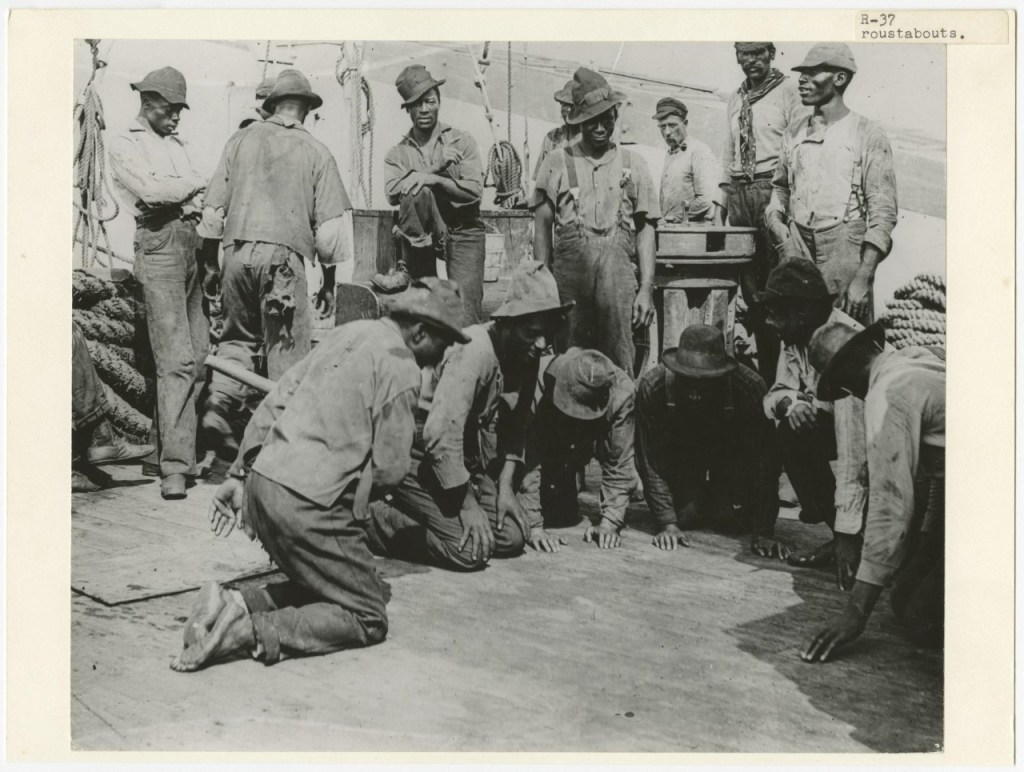
SEE! /The Roustabouts HELL-HOLE, Where 32 Men Slept. Yes, the featured sign at the center of my blog points to the River Queen‘s ties to Hollywood and her use as a restaurant and museum, but it does more than that. Perhaps in surprisingly frank, eye-catching fashion, the sign dramatizes the work life of Black steamboat roustabouts, without whose labor the packets could not have operated. A visual reminder of what Dr. Walter Wyman, of the U.S. Marine Hospital Service, described in 1882 as “the roughest life there is,” and a further reminder of what George Arnold, a former river roustabout, characterized in 1936 as “the life of a dog.”
(To read further about steamboat roustabouts, see my book, Shantyboats and Roustabouts: The River Poor of St. Louis, 1875-1930 (Louisiana State University Press, 2022), especially chapters 3, 5.
 Lost River Stories
Leave a comment