

By Gregg Andrews
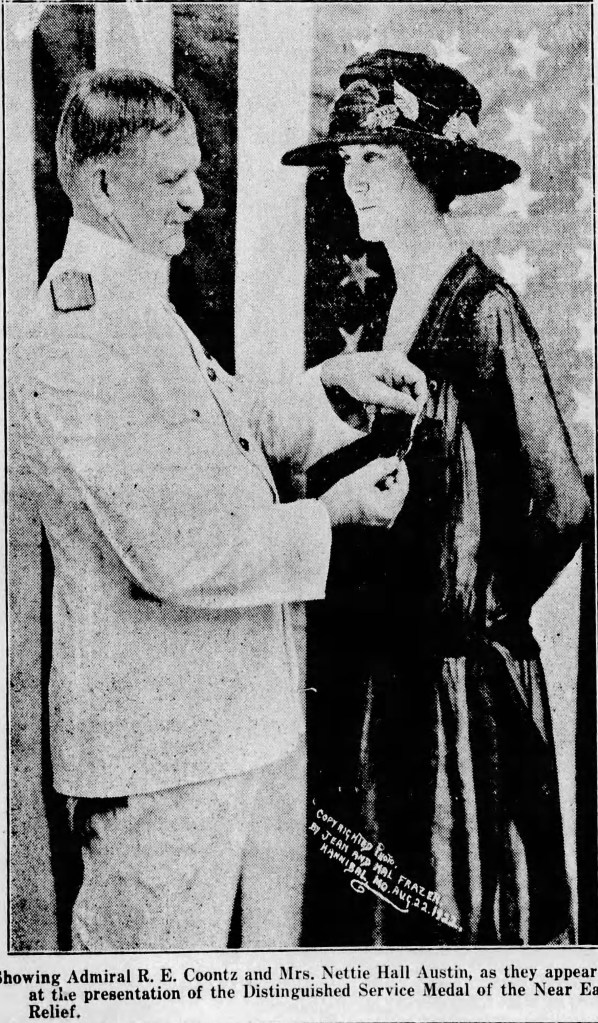
On August 22, 1922, the Mississippi River town of Hannibal turned out in full force for ceremonies that brought home two of its highly popular citizens. Admiral Robert E. Coontz presented the Distinguished Service Medal of the Near East Relief organization to Nettie Hall Austin. National and state officers of Near East Relief attended the presentation, but by special arrangement, Admiral Coontz performed the ceremonial honors. When I came across the name of Nettie Hall Austin for the first time, it was not in connection to her service in the United States Navy, the First World War, or postwar Near East Relief. I was researching her connections to the Hannibal labor movement before the war. She piqued my curiosity, so I kept digging into her background. As a former Hannibal resident, of course, I knew full well the stature of Admiral Coontz, but who was Nettie Hall Austin? Today, an armory bears Admiral Coontz’s name in Hannibal, but little, if anything, is remembered about Nettie Hall Austin. I hope the following profile that I’ve written based on my research to date will shed at least partial light on who she was, and why she appeared with Admiral Coontz in the ceremonial photo below.
Born in Ralls County, Missouri, Nettie B. Hall grew up in Hannibal in the home of her working-class parents, George H. Hall and Esther M. Pennewell. They attended the Fifth Street Baptist Church. Census records indicate that Nettie was born in 1877, but according to government records, she was born on March 18, 1884. As we’ll see, she might have lied about her age to meet the age requirements (18-35) when she joined the United States Navy. Her mother was a seamstress, and her father, a former soldier in the Union cavalry, worked for the “Katy” railroad in the Hannibal roundhouse. In 1895, Nettie and her parents reportedly were offered tempting jobs in the Humphreys-Spahr Shoe Company’s factory in Montgomery City, but her father began to suffer the crippling effects of rheumatoid arthritis that sidelined him in the final decade of his life.
On December 24, 1903, Nettie married Charles W. Austin, a brakeman on the “Katy.” They married in Quincy but took up residence at 1030 Park Avenue on Hannibal’s southside. Nettie refused to be constrained by the bonds of matrimony when it came to pursuing her own career and independence. “The wife who lives with a husband for whom she has no love or respect, simply for the sake of having spending money, a home and a good time,” she later wrote, “is a legalized prostitute.” I haven’t found evidence of their divorce, but they went their separate ways after a half-dozen years or so of marriage. Nettie’s educational training is unclear, but she was a stenographer, notary public, and a talented vocalist and actor who entertained at women’s club events in Hannibal. More and more, she became drawn to politics. In the late 1890s, she developed close connections to John A. Knott, a prominent figure in Missouri Democratic politics who owned and edited the Hannibal Morning Journal. She opened a business in the newspaper office as a public stenographer and notary public. Knott, who was also in charge of Missouri coal oil inspection headquarters in Hannibal, employed Nettie as a stenographer in the office.

Soon, Nettie was called to Jefferson City during the governorship of Joseph W. (“Holy Joe”) Folk, a Democratic crusader against corporate monopolies and corruption. In 1907, she joined the clerical force of the Missouri legislature as a proofreader of records in the office of Republican Secretary of State John Ephraim Swanger. The position served as a springboard for further connections on both sides of the political aisle as she learned her way around the state Capitol. When Floyd W. Brooks, a Republican attorney and representative of St. Louis County’s 2nd district, came to Hannibal on business, she and her husband entertained him in their home in September 1907. When former governor Folk campaigned for the presidential candidacy of Woodrow Wilson in 1912, he hired Nettie as a publicist for the campaign.
Over the next ten years, Nettie blossomed as a writer, political reporter, publicist, and pro-labor Democrat. She developed ties to the Roycroft movement, a reformist group of craft workers, artists, and writers led by Elbert Hubbard in East Aurora, New York. As a writer, she was invited to submit contributions to the group’s journal, The Fra: For Philistines and Roycrofters. In a self-conscious effort to write in the vein of Mark Twain, she coined pithy sayings filled with homespun wisdom that appeared in magazines and journals. “Genius is only a little talent, tacked on to a mighty lot of work,” she wrote in 1916 in The Fra. The Theta Sigma Phi sorority at the University of Missouri honored her for her service in journalism, and the Missouri Writers Guild (1915) included her as a member. In Hannibal, Nettie had close ties to the Hannibal Trades and Labor Assembly. She became the recording secretary of Local No. 322 of the Woman’s Union Label League, an arm of the American Federation of Labor (AFL). To encourage collective bargaining and a harmonious relationship between employers and the AFL, members like Nettie promoted the union label in local political and industrial circles. As a member of the Missouri Press Association and delegate to the central labor body in town, she wrote columns in the Hannibal Labor Journal at the invitation of B. F. (Frank) Brown, its editor and owner. In 1919, the Quincy Whig referred to her as a “prominent political writer.”

The year 1917 was a pivotal one for Nettie. When Ralls County’s Democratic representative, Drake Watson, was chosen as Speaker of the Missouri House of Representatives, he summoned her to be the chief stenographer in the legislature. While in Jefferson City, she sang for prisoners in the state penitentiary. After the United States entered the First World War, her political connections led her to Washington, D.C., where she accepted a position as the chief stenographer in Herbert Hoover’s wartime Food Administration. President Woodrow Wilson’s messianic description of the war as “a war to make the world safe for democracy” resonated with her. In Hannibal, she was put in charge of publicity for a patriotic “Navy Day” recruitment celebration on June 2.
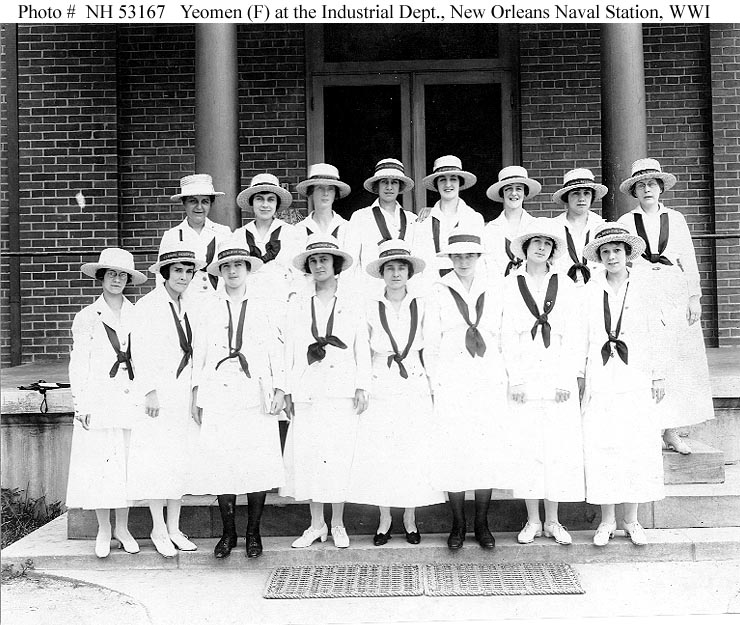
As soon as Nettie arrived in Washington with her widowed mother, Esther M. Hall, she joined the AFL’s Federal Employees Union No. 2. After her mother died at age 77 in George Washington University Hospital on May 10, 1918, Nettie joined the U.S. Navy reserves with an official ranking of Yeoman F, 1st class. Nettie was forty-one-years-old, but only thirty-four-years-old on the record. She and other women in the Navy were often referred to as “yeowomen” or “yeomanettes” at the time. Called to active duty on July 16, 1918, in Dayton, Ohio, Nettie was immediately assigned to the office of the US Navy recruiting inspector in New York City. On December 12, the Bureau of Navigation authorized her promotion to chief publicist for the entire eastern division. Mayors, public officials, dignitaries, and moviegoers on the Eastern Seaboard and parts of Ohio grew acquainted with Nettie as she gave Navy recruiting speeches and delivered two-minute patriotic appeals at move theaters to buy Liberty Bonds. At a meeting to choose temporary officers, the Greater New York Branch of the Enrolled Women’s League of the U.S. Naval Reserve unanimously selected her as chairwoman in January 1919. Due to a lack of funds after the war, she was released from the Navy after more than a year of service on July 31, 1919.
Driven by Wilsonian impulses, a sacrificial spirit of service, and a courageous sense of humanitarian mission, Nettie studied the Turkish language briefly in New York under the aegis of the American Committee for Relief in the Near East (renamed Near East Relief). The committee, although non-governmental, served as an unofficial arm of the United States government. Opening a new chapter in her life on November 1, 1919, she sailed for Constantinople to do volunteer relief work among Armenian Christian refugees in war-torn parts of the dismantled Ottoman Empire. She was the only Missourian in a group of about three hundred volunteers, including Red Cross nurses. On November 28, they reached Constantinople, where Nettie was put in charge of the Yedi Koule orphanage. Soon, she was assigned to Oulou Kichla, a village and solitary station of about 300 people, located on the Berlin-Baghdad Railway approximately 500 miles southeast of Constantinople in the Taurus Mountains. “I am the only woman at the station and the only American woman within a hundred miles,” she wrote to B.F. Brown and readers of the Hannibal Labor Press on January 5, 1920. Major Davis G. Arnold, field director of the committee, and nine other American men who had served in the Navy or Army during the war were at the village station with her. The Turks were distinctly resentful of their presence and hostile to other nationalities. “I am not allowed to go out alone by day and not allowed to leave the house at all at night,” she wrote, “Everybody goes armed in this country, so I felt perfectly at home with my 32 strapped to my belt.”
Volunteer work with Near East Relief thrust Nettie and others into a dangerous postwar environment. At war’s end, the victorious Allied powers carved up the former colonies of Germany and dismantled the Ottoman Empire through League of Nations “mandates.” The mandates gave the victors control over the economic and political development of the oil-rich region, which was plagued by bitter religious conflicts, genocidal ethnic hatreds, and retaliatory cruelties. To complicate matters for the United States, which was a relative latecomer to the world war, a rising Turkish nationalist movement, the exposure of secret treaties promising territorial spoils among the Allied powers, and the triumph of the Bolshevik Revolution in Russia factored into the political equation. Hoping to establish a mandate over Armenia, President Wilson sent an American Military Mission to report on the chaotic conditions in the region, but the United States Senate blocked the president’s plans for such a mandate.

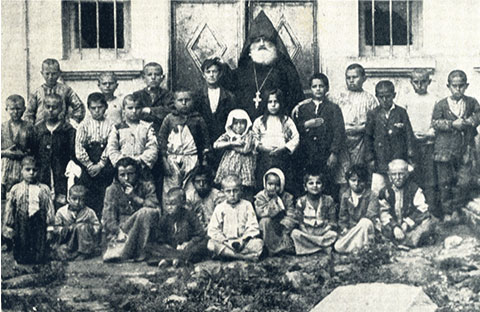
By summer 1920, Nettie’s assignment took her to Sivas, a city of about 60,000 people, mostly Turks. She was stationed in an old Armenian monastery about a mile from Sivas and about 250 miles deeper into the interior. “I am now right in the heart of the territory which saw so many massacres [of Armenians] during 1915,” she wrote on July 14, 1920. “The political conditions over here are very chaotic, further than that I am not permitted to write.” Surrounded by beautiful mountain ranges, she and other relief workers farmed the gardens and fields while using the monastery to house, feed, and care for orphans. The only American stationed there at the time of her letter, Nettie was in charge of 207 orphan girls with the help of a bishop and nearby missionaries who formerly occupied the monastery. For fourteen months, she supervised the girls, whose numbers grew to 350. She led them in daily exercises, cared for them medically as much as possible, taught them work skills, and tried to help them recover psychologically from the unspeakable horrors of war, sexual exploitation, and genocidal policies. Nettie provided limited medical care, not only to the orphans, but also to starving, needy adults suffering from trachoma and other diseases at the station. At Samsun, she reorganized the Near East Relief’s supply and purchasing department. Afterward, she became the inspector of rations and economies for the entire Transcaucasian area. Nettie drew up a schedule of rations which fixed the cost of food at a rate of $1.95 per child. Near East Relief adopted her formula at all of its orphanages with satisfactory results.
Nettie was enamored of the striking beauty of the natural landscape where she was stationed outside Sivas. “When one looks out upon the gorgeous poppy fields, the veritable carpets of wildflowers which cover the whole earth of man over here, when one hears the busy chatter of the blackbirds as they try to get all the best in sight, sees the dignified stork calmly walking around, then it is hard to realize that such things as war and rumors of war are anywhere near. . . I have learned to live a day unto itself and let tomorrow take care of itself.” At times, the emotional strains of relief work were overwhelming. “I recently asked for four days’ leave,” Nettie wrote on July 14, 1920, “and another relief woman and I rented two Arabian horses, took along an Arabian to carry our supplies and we rode forty miles further into the interior to Khangal. We rode twenty miles a day, which is pretty good in the mountains, and these are not hills, I can tell you, they are the REAL thing. We camped out at night. We had no tent, didn’t want one, but we had relief cots and we stretched these under the wonderful starlit heavens, beside a running stream, and slept, slept, slept.”
On June 11, 1922, nearly three years after Nettie began relief work, she returned to New York on a leave of absence. After stopping in Chicago to visit her cousin, Rev. Almer C. Pennewell, pastor of the Covenant Methodist Episcopal Church in Evanston, she went to St. Louis, the state’s Near East Relief headquarters. In an interview with a St. Louis Star reporter shortly before she boarded a train to Hannibal to be honored in a ceremony with Admiral Coontz, Nettie said that her service in Near East Relief amounted to a tribute to her mother. Pointing to the world’s largest children’s orphanage in Tiflis (Tbilisi), Georgia, which housed 12,000 girls, Nettie told the reporter, “I have seen and heard things over there that haunt me at night when I want to sleep. But I can’t talk much about them.” She called attention to the intolerable living conditions inflicted by war. It became routine for her to find abandoned infants on the doorstep of the mission. She recalled that on one particular day, five abandoned babies were left there. In many cases, it was too late to save the infants. “I thought I loved my country when I enlisted as a yeoman in the navy at the outbreak of the war,” Nettie said with tear-filled eyes, “but I never knew what America really meant until I saw it again after being over there.”

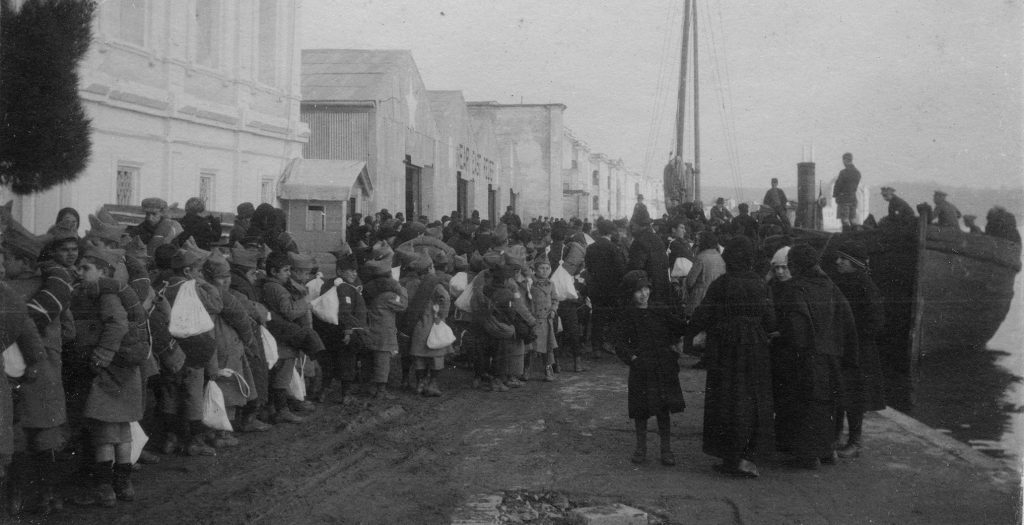
Nettie’s leave of absence ended abruptly. She was called back to a new refugee crisis due to the burning of the port city of Smyrna. She sailed overseas again on September 20, 1922. In Constantinople, she oversaw the transfer of 788 Armenian and Greek orphans to Greece after the recapture of Smyrna by Turkish nationalist military forces. She did relief work in Athens until July 1923. Upon returning to the United States, she spent time in New York, Washington, D.C., and St. Louis before returning to Hannibal on September 6, 1923.
Nettie’s experiences in Near East Relief were life changing. Highly recommended by the Lyceum Bureau, she spoke to women’s clubs and organizations on the Holy Land, conducted research at the University of Missouri in Columbia, and continued fundraising for Near East Relief. At a meeting of the Missouri Democratic Press Association in Kansas City on April 13, 1929, she was chosen again as a vice-president representing the 16th Congressional district in St. Louis. Her experiences and skills led her to enroll in a school of social work and to pursue a career in social welfare work in the Great Depression. Nettie married Olin Hudson, a war veteran, but by 1936, she was a widow who went by the name of Nettie Hall Hudson. In Depression-Era Las Cruces, New Mexico, Doña Ana County employed her as the supervisor of social welfare work, but in 1940, Nettie was in a Veteran’s Administration facility in Beverly Hills township, Los Angeles, California. She died on June 21, 1961.
Selected sources: Hannibal Labor Press; Hannibal Morning Journal, Hannibal Courier-Post, Near East Relief, Ralls County Record, Jefferson City Post-Tribune, Brooklyn Daily Times, Quincy Whig, Quincy Daily Journal; Chicago Tribune, St. Louis Star; Albuquerque Tribune; Times Herald (Washington, D.C.); Los Angeles Times; “The Official Roster of Ohio Soldiers, Sailors, and Marines in the World War, 1917-1918,” Volume 20, U.S., Adjutant General Military Records, 1631-1976; Passport Applications, January 2, 1906 -March 31, 1925, U.S., Passport Applications, 1795-1925; Federal Censuses, 1880 to 1950; U.S., Social Security Applications and Claims Index, 1936-2007; Lyceum Magazine; The New Near East 7 (September 1922); Hannibal City Directories; Official Manual of the State of Missouri; United States Veterans Administration, Master Index, 1917-1940; Nathaniel Patch, “The Story of the Female Yeomen During the First World War,” Prologue Magazine 38 (Fall 2006); Near East Museum Archives; Maj. Gen. James G. Harbord, U.S. Army, “Report of the American Military Mission to Armenia,” 1920; James L. Barton, Story of Near East Relief (1915-1930), 1930.
 Lost River Stories
Leave a comment