
By Gregg Andrews
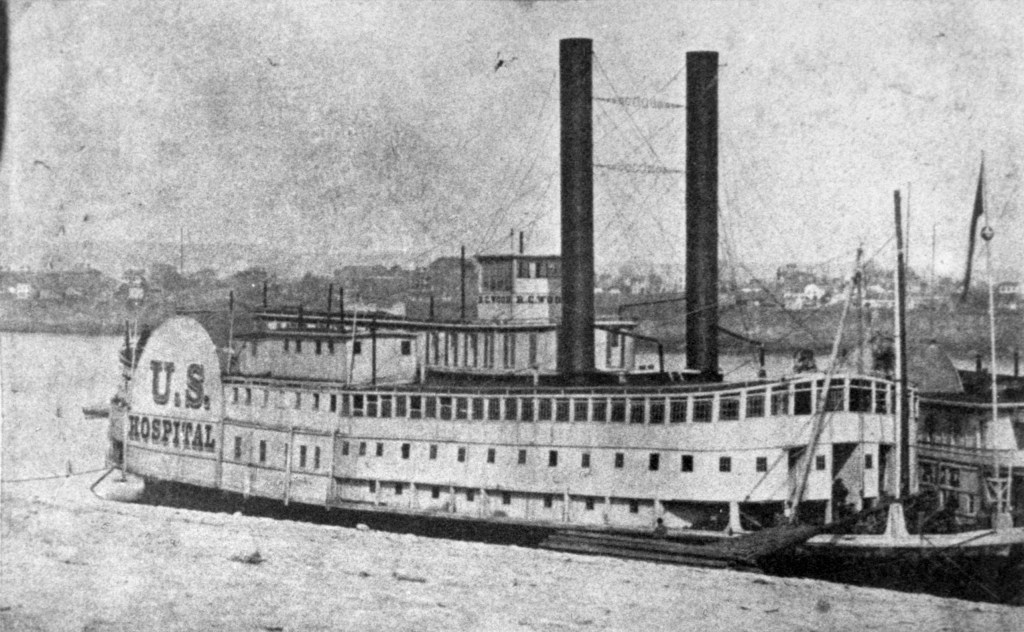
In 1857, the St. Louis and Keokuk Packet Line added the City of Louisiana, a sidewheel steamboat, to its growing fleet on the Upper Mississippi. Built expressly for passengers rather than freight, and named for the town of Louisiana, Missouri, the boat’s hull was built in Madison, Indiana, and towed to St. Louis. Samuel Gaty and John S. McCune, the president of the packet company, oversaw the addition of her machinery at their foundry in St. Louis and outfitted the cabin. Two hundred and fifty feet in length with a forty-foot beam and a six-and-a half-foot hold, the boat was built for speed and beauty.
At the outset of the Civil War, Union forces used the packet company’s City of Louisiana to transport troops, but the wartime service of the steamboat soon expanded. After the Battle of Wilson’s Creek near Springfield, Missouri, on August 10, 1861, the Western Sanitary Commission (WSC) was formed in St. Louis as a private charitable agency to help treat sick and wounded combatants. General John C. Fremont authorized the WSC, which functioned as an unofficial arm of the US Sanitary Commission in the West. James E. Yeatman, a staunch St. Louis Unionist and member of the St. Louis and Keokuk Packet Company, became the WSC’s president. The WSC relied on private donors for financial support to build hospitals and provide food, medical supplies, and nurses. Its mission later expanded to include caring for war refugees and freedmen in the South.

The City of Louisiana and several steamboats served as “floating hospitals” in the Mississippi River Valley. After Union forces under the command of General Ulysses S. Grant captured Fort Donelson on the Cumberland River in February 1862, the WSC sent a St. Louis delegation to Paducah. General Grant’s medical director suggested the conversion of several steamboats into floating hospitals to remove and care for the wounded. With the approval of Major General Henry W. Halleck, members of the WSC worked with the chief quartermaster to charter the City of Louisiana. The state rooms were removed, and the upper deck was made into a single ward with hot and cold water, cooking apartments, nurses’ rooms, and laundry and medical facilities. The government supplied her with beds and commissary stores, and the WSC spent $3,000 to complete her readiness. The commission supplied assistant surgeons and sanitary stores. Working with Dorothea Dix, the appointed “Superintendent of Women Nurses,” the WSC also lined up a supply of nurses for service on the City of Louisiana. On March 20, the steamer was ready as a floating hospital.

After the battle of Pittsburg Landing, Tennessee (Shiloh) in April 1862, the City of Louisiana transported 3,389 patients to northern hospitals. She was so effective that in April 1863, the government purchased and renamed her the R.C. Wood in honor of the Assistant Surgeon General of the United States. With room for 500 beds, the R.C. Wood made repeated trips in the summer of 1863 to transport the wounded from Vicksburg to St. Louis hospitals. After the WSC reported that at least 50,000 destitute freedmen behind Union lines were living under wretched conditions of starvation, sickness, and disease, President Abraham Lincoln approved the WSC’s request to expand its mission by caring and providing for them.
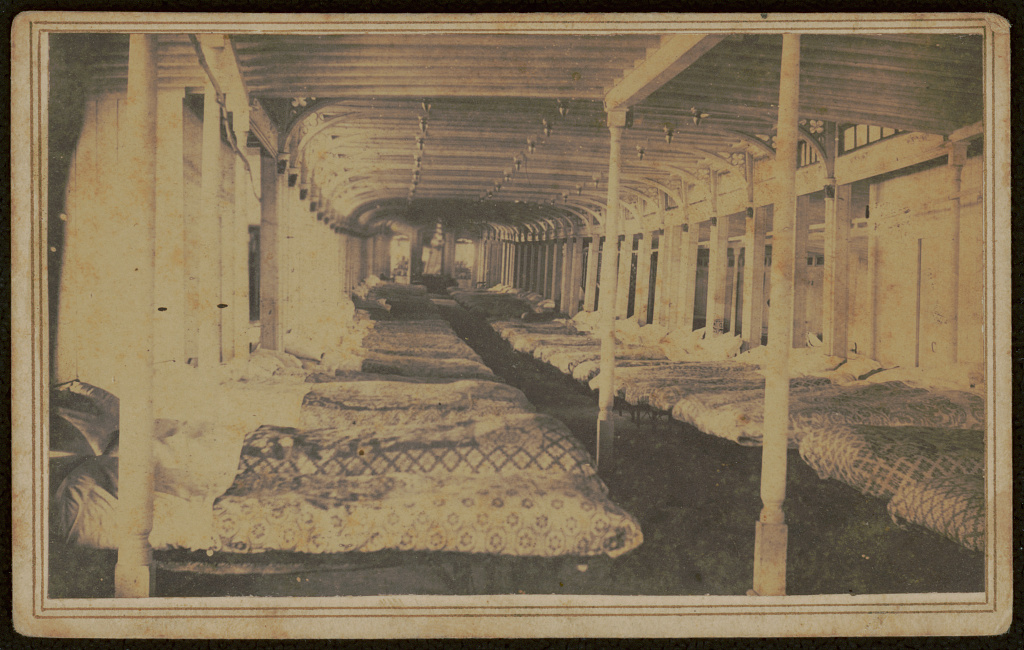
Between April 1863 and April 1864, the R.C. Wood made thirty-five trips between St. Louis, Memphis, Vicksburg, Louisville, and New Orleans. On those trips, the floating hospital carried 11,024 sick and wounded patients. In November 1865, Michael S. Mepham and his brother, William G. Mepham, of St. Louis bought the sidewheeler, originally the City of Louisiana, at a government auction sale for $7,000. In August 1866, the St. Louis Board of Health chartered the R.C. Wood from Mepham and Bro. for use during a quarantine, but on January 26, 1867, the steamer sank opposite the far southeastern St. Louis neighborhood of Carondelet.
Selected Sources: William J. Petersen, “The Keokuk Packet Company,” Iowa Journal of History (July 1952): 193-208; John Thomas Scharf, History of St. Louis City and County (Philadelphia: Louis H. Everts & Co., vol. II, 1883), pp. 1112, 1115; Daily Missouri Republican (St. Louis), May 3, 1857, p. 2, and May 24, 1862, p. 2; Hannibal Weekly Messenger, September 10, 1857, p. 1; St. Louis Globe-Democrat, July 16, 1861, p. 3; Courier-Journal (Louisville), November 25, 1865, p. 3; J.G. Forman, The Western Sanitary Commission: A Sketch (St. Louis: R.P. Studley & Co., 1864), 25, 43, 44, 106; Final Report of the Western Sanitary Commission (St. Louis: R.P. Studley & Co., 1866); Reports of Western Sanitary Commission, 1862-1865.
 Lost River Stories
Leave a comment